


Business Fraud Insurance: Combating the Growing Threat of Fraud with Prevention and Protection
The Rising Threat of Business Fraud: Business fraud has emerged as a fast-growing, increasingly sophisticated threat to companies of all sizes. Experts warn that fraud is now among the “most prevalent problems” facing businesses. From rogue employees embezzling funds to cybercriminals tricking staff via phishing emails, organizations worldwide are losing significant sums to fraud every year. In fact, studies estimate that companies lose about 5% of their annual revenue to fraud on average – a staggering cost that can run into millions of dollars per incident. Nearly half of organizations (51%) have experienced fraud in the past two years alone, underscoring how common these schemes have become. Even more troubling, fraudsters are exploiting technology and remote work to devise new scams, making the “threat of loss more ominous than ever before,” especially for companies that aren’t prepared.
 Fraud schemes can originate inside or outside the organization. Internal (occupational) fraud — such as employees stealing assets, falsifying records, or colluding with vendors — remains a dominant risk. A global fraud study found that once fraud strikes, a “typical case” lasts about a year before detection and causes a median loss of six figures, with some cases averaging over $1.5 million in damage. External fraud is also on the rise: cyber thieves and social engineers prey on businesses through scams like phishing, CEO impersonation, and fraudulent vendor invoices. In fact, over 40% of companies that suffered fraud reported incidents of cyber or “platform” fraud (e.g. fraudulent online payments or phishing attacks) as bad actors exploit digital vulnerabilities. Given this landscape, prevention and early detection of fraud are more critical than ever, alongside robust insurance coverage to absorb losses when all else fails.
Key Internal Weaknesses that Enable Fraud
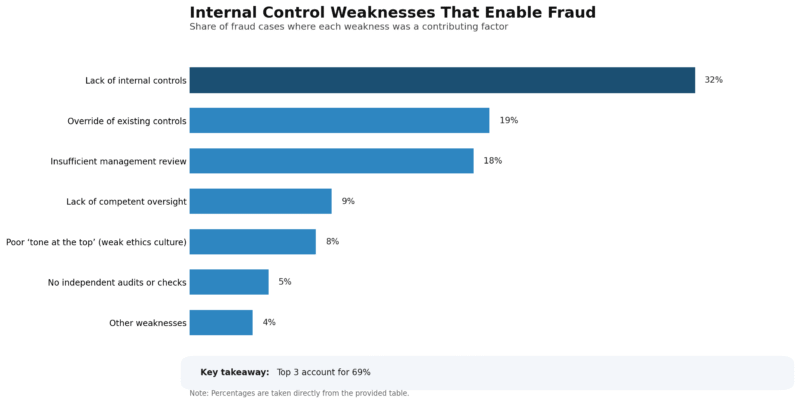
A strong defense against business fraud starts from within. Most occupational fraud exploits weaknesses in a company’s internal controls – the checks and balances meant to prevent and catch wrongdoing. According to the Association of Certified Fraud Examiners (ACFE), the primary internal control weaknesses that contribute to fraud cases include:
- Lack of Internal Controls (32%) – Inadequate segregation of duties, oversight, or safeguards, creating gaps that fraudsters exploit.
- Override of Existing Controls (19%) – When managers or employees can bypass or ignore controls (for example, fraudsters in authority “bending the rules”).
- Insufficient Management Review (18%) – Little to no regular review of financial statements, accounts, or processes by higher management, allowing irregularities to go unnoticed.
- Lack of Competent Oversight Personnel (9%) – Not having skilled, ethical staff in oversight roles (such as internal audit or compliance), which reduces the ability to monitor and enforce controls.
- Poor “Tone at the Top” (8%) – Leadership not emphasizing ethics or accountability, which can foster a culture where fraud is more likely to occur or be ignored.
- Lack of Independent Audits/Checks (5%) – Few independent inspections, audits, or reconciliations of accounts, meaning errors or fraud can continue unchecked.
- Other Weaknesses (4%) – Miscellaneous factors (e.g. weak IT controls, no background checks) that together account for the remainder.
These vulnerabilities illustrate how internal failures can open the door to fraud. Without formal controls, oversight, and an ethical culture, even a single dishonest employee can exploit the system. Strong internal controls reduce the opportunity for theft and fraud by establishing clear accountability and multiple layers of approval. For example, businesses should enforce segregation of duties (so no one person controls an entire financial process), conduct management sign-offs and reviews of transactions, and implement independent internal or external audits. Addressing the weaknesses above – by tightening controls and policies – directly cuts off the avenues that fraudsters typically use.
Common Anti-Fraud Controls – The good news is that many companies are already implementing protective measures. The ACFE’s 2024 data shows that a majority of organizations have put in place various anti-fraud controls to safeguard their operations. The table below summarizes the most common anti-fraud controls companies use, along with the percentage of organizations using each control:
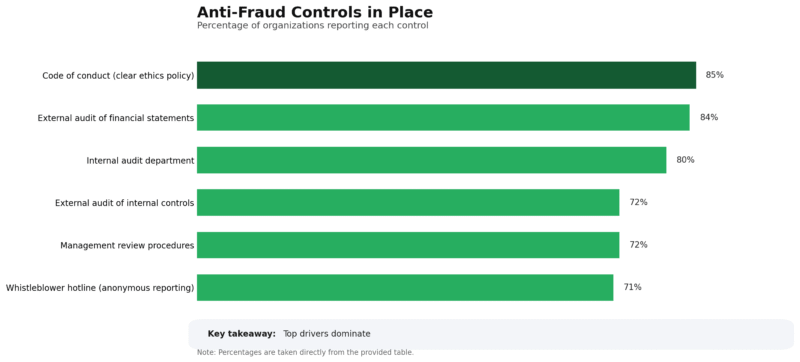
Table: Top internal control weaknesses that contribute to fraud, and the most common anti-fraud controls companies use (with prevalence rates). Source: ACFE Occupational Fraud 2024.
As the table and chart show, gaps in internal controls correlate with fraud cases, but organizations can respond by establishing strong anti-fraud measures. For example, virtually all larger companies have a formal Code of Conduct (adopted by 85% of organizations) to set ethical expectations. Financial oversight measures are common as well, such as external financial audits (84%) and dedicated internal audit departments (80%) that continually review transactions. Management-level controls – like requiring executives to certify financial statements and perform periodic reviews – are in place at most companies, as are confidential whistleblower hotlines that encourage employees to report suspicions anonymously. These controls have proven value: organizations with a combination of strong controls tend to detect fraud faster and suffer less loss when fraud does occur. In fact, ACFE data shows the presence of certain anti-fraud controls was associated with 50% lower fraud losses and duration on average, compared to victims lacking those controls. The takeaway is clear – investing in internal controls and oversight works, significantly reducing both the likelihood of fraud and its financial impact.
The Critical Role of Fraud Awareness Training
Even the best controls won’t stop all fraud, especially if employees are not vigilant. This is where fraud awareness training becomes crucial. Empowering your team to recognize red flags and respond appropriately can dramatically improve fraud prevention and detection. According to the ACFE, “awareness is the best defense against fraud,” and organizations that provide anti-fraud training for their staff end up far better off. Over the past decade, more companies have started training their employees and managers on fraud risks – 63% of firms now train employees (up from 52% in 2016), and 62% provide fraud training to managers/executives (up from 51% in 2016).
Crucially, companies without fraud awareness programs suffer much harsher losses. One study found that organizations which “skipped” employee fraud training lost nearly twice as much money to fraud as those that trained their staff. Training also enhances detection: whistleblowers are far more likely to report fraud if they’ve been trained on what to watch for. In fact, 67% of employee fraud tips came from those who had received fraud awareness training, versus only 33% from employees with no training. This makes sense – knowledgeable employees can spot suspicious behaviors or requests (like an unusual payment instruction or accounting irregularity) and are encouraged to speak up. Given that tips are by far the most effective means of detecting fraud (accounting for 43% of cases detected), educating employees is arguably one of the highest ROI investments in fraud prevention.
Effective training strategies cover more than just basic definitions. Experts recommend programs that discuss real-world fraud case examples, teach employees how to identify warning signs (for both internal schemes and external scams like phishing), and clearly outline reporting procedures (e.g. how to use the company’s hotline or report to management). Training should also emphasize the big picture impact of fraud – employees learn that fraud losses hurt the entire organization’s profitability, reputation, and even job security. By instilling a culture of honesty and vigilance (often referred to as setting the proper “tone at the top”), leadership can ensure that every staff member becomes a first line of defense against fraud. The bottom line: well-trained employees and managers are far more likely to stop fraud before it grows, either by avoiding accidental mistakes that enable fraud or by promptly reporting suspicious activity. Combining robust internal controls with ongoing fraud awareness education gives your organization a powerful one-two punch in the fight against fraud.
Insurance: A Safety Net for Fraud Losses
While preventive controls and training can greatly reduce risk, no business is 100% immune to fraud. Fraud tactics continually evolve, and even diligent companies can fall victim to a clever scheme. That’s why Business Fraud Insurance is an essential backstop – it helps your company recover financially from losses if fraud or theft does occur. ALIGNED Insurance strongly advises firms to maintain a comprehensive Crime Insurance policy as a necessity for protecting their assets in today’s environment. In fact, Crime Insurance (sometimes called “employee dishonesty” or “fidelity” coverage) is designed specifically to reimburse an organization for losses of money, securities, or property due to internal crimes like theft, fraud, or forgery. For example, if an employee embezzles funds or a staff member colludes with a vendor to overbill the company, a crime/fidelity insurance policy can indemnify the business for those losses.
Modern fraud threats often blur the line between physical and digital incidents, so ALIGNED offers several specialized products to cover a wide range of fraud scenarios. Key insurance coverages that can mitigate fraud losses include:
- Crime Insurance (Fidelity Bond) – Protects against employee theft, embezzlement, forgery, robbery, burglary, and other dishonest acts that cause financial loss to the company. This coverage ensures that if an employee or someone entrusted with company assets commits fraud, the business can recover stolen funds up to the policy limits.
- Social Engineering Fraud Insurance – Covers losses from deception-based scams where criminals manipulate staff into making unauthorized payments or divulging confidential information. This includes schemes like phishing emails, CEO fraud, vendor impostor scams, and other social engineering attacks that trick employees into transferring money or revealing access to funds. Even diligent employees can be fooled by sophisticated scams, so this coverage fills a critical gap by paying for losses if your team is duped by fraudulent instructions.
- Cybercrime and Fraud Coverage – Provides protection against cyber-enabled theft and fraud, such as hacking, malware attacks, ransomware, and other cyber incidents that result in financial loss. For instance, if hackers infiltrate your network and steal funds or sensitive data (leading to regulatory fines and customer notifications), a cyber insurance policy can help cover the costs. Cybercrime coverage often overlaps with social engineering coverage, ensuring that phishing-related losses are insured even if they don’t involve an authorized voluntary transfer (for example, a hacker directly injecting fraudulent transactions into your bank accounts).
These insurance solutions serve as a critical safety net. They do not replace strong controls – rather, they complement your fraud prevention efforts. In practice, if your internal safeguards fail or an employee makes an error, fraud insurance steps in to limit the damage, allowing your business to recover financially and continue operating. As an example, consider a scenario of “CEO impersonation” fraud: an employee receives a convincing email purportedly from your CEO instructing a wire transfer to a supplier. If the employee is tricked and sends the money to a fraudster’s account, the company could lose tens or hundreds of thousands of dollars. Social engineering fraud insurance or computer fraud coverage would enable the company to recoup that loss, whereas without insurance the funds might be gone for good. In essence, business fraud insurance gives you peace of mind that even if a fraud incident slips through your defenses, your organization won’t have to bear the full brunt of the financial loss.
ALIGNED’s Audit. Optimize. Execute.™ Approach to Managing Fraud Risk
To fully protect your business from fraud, a holistic strategy is best. ALIGNED Insurance follows a proprietary Audit. Optimize. Execute. (A.O.E.) process that integrates risk assessment, control improvements, and insurance solutions into one comprehensive approach. Here’s how it helps guard against fraud and financial crime:
- Audit – Identify Exposures: Every engagement begins with a thorough risk and insurance audit. ALIGNED’s experts dive deep into your business operations, financial controls, and existing insurance policies to uncover any weaknesses or gaps. This is where they might discover, for example, that a lack of segregation of duties in accounting could enable fraud, or that your current insurance policy has a crime coverage limit that is too low. By investing significant time in this Audit stage, ALIGNED ensures no important detail is missed – it’s a complete fraud risk check-up for your organization. According to ALIGNED, this rigorous audit “leaves no opportunity unexplored,” giving a clear picture of where your company is most vulnerable.
- Optimize – Strengthen Controls and Coverage: With the audit findings in hand, ALIGNED moves to optimize your risk management program. This means fixing the weaknesses identified – for instance, recommending stronger internal controls or oversight processes to address any gaps. It also means optimizing your insurance coverage: aligning your policies with your actual risks and making sure you have the right endorsements or higher limits where needed. In the context of fraud, the Optimize phase might involve updating your crime insurance limits, adding social engineering fraud coverage if you lack it, or ensuring your policies have no unintended gaps (e.g. a newly acquired subsidiary might need to be added to the coverage). The goal is to tailor both controls and insurance to your business’s unique needs, so that you’re neither under-protected nor overpaying for redundant coverage. Many clients discover that this process not only improves their fraud resilience but also often uncovers cost savings – for example, by eliminating overlapping coverages or qualifying them for better rates due to risk improvements.
- Execute – Implement and Monitor: Finally, ALIGNED helps execute the plan by putting the recommended solutions into action. This can include assisting with updating internal policies, facilitating employee fraud awareness training, and placing the optimized insurance coverages. The Execute stage is about seamless implementation – ALIGNED ensures that all changes (new controls, new policies, etc.) are executed properly and that you and your team understand how to maintain them going forward. Fraud risk management isn’t a one-time set-and-forget; it requires ongoing vigilance. ALIGNED continues to work with clients over time, for instance by scheduling regular insurance program reviews or audits each year to adapt to any new fraud threats or changes in the business. Companies that continually cycle through this Audit–Optimize–Execute loop become markedly more resilient against fraud and other risks. They can adapt quicker to emerging threats (like the latest cyber fraud schemes) and are far less likely to be caught off-guard by internal issues, which ultimately safeguards their bottom line.
By following this A.O.E. methodology, ALIGNED integrates proactive risk management with insurance in a way that ensures all bases are covered. No single safeguard is foolproof on its own – but by auditing for weaknesses, strengthening controls, training employees, and backing it all with the right insurance coverage, your business can stay one step ahead of fraudsters. ALIGNED’s motto, “How we do it matters,” reflects this comprehensive philosophy – careful upfront analysis and strategic planning lead to better outcomes than a hasty, patchwork approach. Clients who embrace the Audit. Optimize. Execute. process often report not only greater peace of mind but also tangible benefits like reduced losses and even lower insurance premiums over time (thanks to the improved risk profile). In short, ALIGNED’s approach makes sure that your fraud prevention measures, insurance policies, and overall risk strategy are fully aligned with the realities of today’s fraud threats.
Protecting Your Business in the Era of Fraud: In an age when business fraud is both common and constantly evolving, companies must take a dual approach: prevent what you can, and insure against what you can’t. Start by shoring up your defenses internally – implement strong controls, foster an ethical culture from the top, and train your people to be fraud-aware. This will deter many schemes and help catch issues early (often via employee tips, which remain the #1 fraud detection method). At the same time, prepare for the unexpected by securing the right fraud insurance coverages (crime, fidelity bonds, social engineering fraud, cybercrime, etc.) so that if a major incident occurs, your company can recover swiftly without devastating financial loss. ALIGNED Insurance’s specialized expertise in Business Fraud Insurance and risk management can be an invaluable resource in this process. Don’t wait until after a fraud happens to act – the most successful organizations tackle fraud risk proactively.
Ready to fortify your business against fraud? Contact ALIGNED Insurance to learn how our team can help audit your current risk controls, optimize your insurance program, and execute a plan to keep your company safe from fraud. With ALIGNED’s guidance and our proprietary Audit–Optimize–Execute approach, you can confidently face the future knowing your business is protected against even the most cunning fraudsters. For a personalized fraud risk consultation and to explore the tailored crime and fraud insurance solutions that will best safeguard your organization’s finances and reputation. Together, we can ensure that fraud protection is fully ALIGNED with your business needs.
Click Here To Get A Crime/Fidelity Insurance Quote From ALIGNED Today!
Sources referenced: